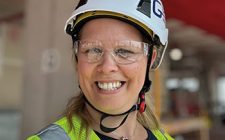
Master Plumber Lucy Mawer

CIPHE member Lucy Mawer takes time out of a journey to London for the Construction Industry Council’s #CICat30 event to talk more about her role in the industry.
Becoming a Master Plumber needs dedication, but you can do it.
I started learning plumbing when I was 20. My family were all hands-on people. When I started out, one of my lecturers got their Master Plumber status and I was set. I thought ‘that’s where I want to go’. I’m getting my status early next year. I’m still plumbing, I’ve got to keep myself up to date.
Opportunities can come when you least expect them.
It all started when I went into my old college to find another apprentice. They asked would I like to take on a group of girls. They were worried about taking on a stream of 10. Some had difficulties and had been failing at school. I like seeing someone who was labelled ‘difficult’ getting qualified and going on site. It’s very satisfying.
The CIPHE has been there every step of the way.
It’s fantastic. It’s been there from the start and I try to encourage young people to use it to go into the industry. The e-learning with the CIPHE is brilliant and I make the kids do it. It’s really important they get their CPD. Keeping learning and skills up to date is important so I can keep my teaching relevant.
Smart heating systems and diagnostic systems can’t be avoided.
You already have to have a Level 1 minimum in ICT and you can’t be a technophobe now so just accept it as that’s the way that it’s going. For older practitioners I’d say ‘you can do it, it’s easier than you think’.
Learning about technology shouldn’t be at the expense of getting the basics right, like installing good pipework. You’re still going to come across a lead pipe joint and need to know how to replace it according to the regulations. It’s the small things that get overlooked. The cistern in a Byelaw 30 boiler should have the lid on top and insulation. You’d be surprised how many don’t.
You’ve got to dedicate yourself to customer service.
Go to a customer with more than one product – it doesn’t have to be the same manufacturer – and give someone options. A lot of manufacturers do a performance sheet, so have this to hand. It’s making sure you back up what comes out of your mouth with the piece of paper that proves what you’re saying.
Rogue traders are going round causing trouble for us. I absolutely love helping out the older people who are my longest customers. If it’s a toilet and it’s only dripping, it’s good to put their mind at rest. We shouldn’t be charging the earth for pensioners.
Safety is everyone’s business and setting an example on site with personal protective equipment (PPE) is crucial.
PPE is for everyone. When I go on large building sites, there will be everyone abiding by the rules. It’s important to set an example for young apprentices. But you’ll get a sole trader on site who’s doing a quick job and they’re not using the kit. It’s easy when you’ve got a lot on, but if you’re cutting a tile without glasses and it splinters, you’ve had it. You can’t fill out the accident report if you’re dead, so it’s PPE all day.
Asbestos will kill you and anyone near you.
People should be very aware of dealing with it because it’s not just about you. If you create dust, everyone else in the vicinity will breathe it in. There’s the Health and Safety Executive’s website, which has so much research. There’s an interactive learning section – and it’s all free, so there are no excuses.
Manufacturers have a strange idea of what a plumber looks like, especially female plumbers.
I saw one ad that featured a very slim, blonde model. We’re not all like that, but an apprentice can think that’s how they’re supposed to be. You don’t need a male model to sell a crimping tool either. Attitudes are changing and site managers need to move with them.
We need to change negativity in job roles. It comes down to views of where people need to be placed. There’s enough regulation to protect people on site. There’s no job a man does in this industry that a female can’t do. Take bending copper pipes. It’s a technique: get the technique right, get your muscles working properly and you can do it. As new people come in, it won’t be an issue. But why wait?
New female apprentices worry a lot.
It is often confidence – particularly when they go on work experience. It’s good to ask questions, so absolutely say ‘I don’t understand’. We’ve all got to learn.
Don’t let them get you down.
I’ve had my share of sexist comments and there’s no place for it. I don’t want anyone else to go through that. It’s getting better: like a lot of things, we’re getting there.
I don’t think of myself as a campaigner. I’m just standing up for what I believe and I’m not afraid to say it.
Best practice
How to become a Master Plumber
The applicant must provide evidence of achieving qualifications equivalent to NVQ Level 3 with suitable experience.
A further requirement is that the applicant must be registered as either an Engineering Technician, Incorporated or Chartered Engineer with the Engineering Council.
A panel formed from representatives of the CIPHE and the Worshipful Company of Plumbers will assess all applications.
Following submission of all relevant documents, including independent references, successful applicants will be awarded a Master Plumber Certificate.
This article first appeared in the Nov/Dec 2019 issue of P&H Engineering, the magazine for members of the CIPHE. Find out how to join here.
You might also like

Meet the member: Chris Chapman
Meet the Member – Mark Brown