Balancing heating systems

In the UK, as energy costs continue to rise and environmental pressures intensify, optimising heating systems has become a critical priority for homeowners, businesses, and installers alike. Hydronic balancing stands out as a fundamental practice in this endeavour, offering a pathway to enhance system performance, reduce energy consumption, and improve comfort levels across all modern heating technologies.
Hydronic balancing is particularly beneficial for condensing boilers as they operate most efficiently when the return water temperature is maintained below the 54°C dew point. This temperature threshold allows the boiler to consistently function in its condensing mode, where it can recover latent heat from flue gases – a process essential for achieving peak performance and minimising operational costs. By optimising flow and return temperatures through hydronic balancing, condensing boilers can deliver on their promise of energy efficiency and cost savings.
The importance of hydronic balancing is further magnified in systems utilising heat pumps. These systems are designed to achieve peak efficiency at low flow temperatures, and their performance – measured by the Coefficient of Performance (CoP) – is highly sensitive to the system’s return temperature. Without precise hydronic balancing, uneven flow distribution can lead to some emitters being starved of heat, forcing the heat pump to compensate by operating at a higher, less efficient temperature. This compromises the very efficiency that makes heat pumps a desirable low-carbon solution. A correctly balanced system ensures the stable, low-temperature operation required to maximise the heat pump’s coefficient of performance and deliver on its promise of energy savings.
Moreover, Building Regulations Part L in the UK requires installers to design and fit heating systems for maximum energy efficiency. These regulations mandate the use of self-regulating controls and detailed heat loss calculations. Hydronic balancing is integral to this process, providing the foundational control needed to ensure any high-efficiency system – whether a boiler or a heat pump – operates in compliance with regulatory standards and achieves its designed performance.
Building Regulations Part L requires engineers replacing a heat source to ensure new systems operate at lower flow temperatures (around 55°C or less). It mandates the installation of advanced controls such as thermostatic radiator valves (TRVs) in every room, the thorough cleaning and flushing of existing pipework according to BS 7593:2019, the insulation of exposed pipes, the proper commissioning of the system with magnetic filters, and the provision of clear instructions on energy efficiency and documenting evidence of compliance.


Why balance systems?
Hydronic balancing is widely recognised as a fundamental practice for ensuring heating systems operate according to their design specifications. It involves optimising the flow of water within a system, balancing pressures to ensure even distribution of heat across all radiators. This process prevents cold spots and ensures consistent heating throughout a property, addressing common issues such as uneven heating and noisy radiators. An unbalanced system not only compromises comfort but also leads to increased energy consumption and higher fuel bills.
The physics behind hydronic balancing is rooted in the behaviour of water as it flows through pipework. Pressure drops occur naturally, affecting the flow rate and distribution of heat. By balancing these pressures, installers can ensure that each radiator receives the correct flow of hot water, preventing inefficiencies and discomfort. While hydronic balancing is not currently mandatory, it is considered best practice and is gaining recognition as a key component in energy-efficient heating solutions.

Types of balancing
Static balancing: This traditional method involves manually adjusting lockshield valves on each radiator to achieve equal pressure drop and correct flow. While familiar to many installers, static balancing can be time-consuming and may not provide the accuracy needed for optimal performance. It is typically optimised for full load conditions, which may lead to over-delivery of heat on milder days, resulting in wasted energy. Despite its limitations, static balancing serves as a foundational technique that many installers rely on, especially in systems where automation is not feasible.
Pre-set balancing: This method uses flow limiters with pre-setting functions to calculate the required flow for each radiator. Although more accurate than static balancing, pre-set balancing is still optimised for the coldest days when the heating system operates at full load. This can result in unnecessary high flow rates on milder days, affecting energy efficiency. The Danfoss Installer App simplifies this process by providing an interactive guide for calculating and documenting the pre-setting for each radiator, enhancing system efficiency and saving valuable time. By leveraging technology, pre-set balancing offers a more precise approach, ensuring that systems are fine-tuned for optimal performance across varying conditions.
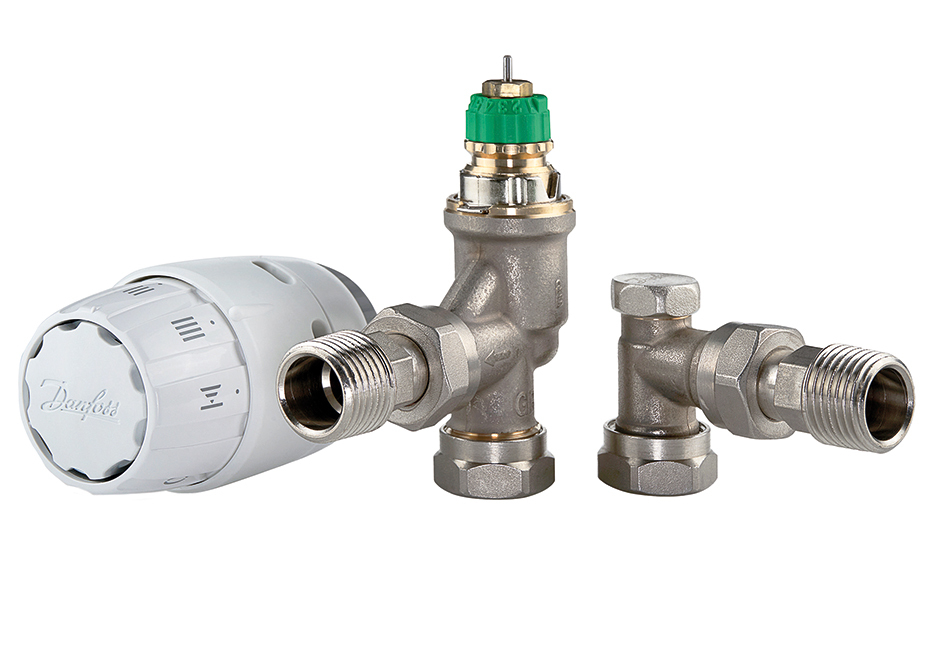
Automatic balancing: Innovative solutions such as the Danfoss RAS-B2 offer automatic balancing by functioning as both a flow limiter and dynamic pressure valve. The RAS-B2 maintains consistent flow regardless of pressure fluctuations, optimising system efficiency and reducing energy waste. Automatic balancing ensures that the system is optimised for all conditions, enhancing comfort and performance. This method represents the future of hydronic balancing, where technology takes the lead in ensuring systems are always operating at their best, regardless of external factors.
Benefits of effective balancing
Effective hydronic balancing offers numerous benefits, including improved comfort, reduced energy consumption, and enhanced system efficiency. One of the key advantages is its impact on condensing boilers. Condensing boilers operate most efficiently at return temperatures below 55°C due to their non-linear efficiency curve. By ensuring that the system is properly balanced, installers can maintain lower return temperatures, maximising the efficiency of condensing boilers and reducing energy costs.
Automated solutions
Advancements in technology are making hydronic balancing more accessible for installers. The Danfoss Installer App offers an interactive guide for calculating and documenting correct flow settings for each radiator. By using the app’s pre-setting tool, installers can perform quick calculations and set TRVs accurately, saving time and improving system performance. The app allows for quick commissioning on-site, generating reports for future reference and ensuring transparency and accountability in system balancing.
Solutions to simplify balancing
A number of solutions are available to simplify hydronic balancing and enhance system performance. Danfoss offers the RAS-B2 dynamic valve, for fast and straightforward hydronic dynamic balancing. The RAS-B2 TRV has a differential pressure controller which ensures that pressure drops over the valve remain constant, maintaining flow at both full and partial loads. This allows for precise control over individual radiators, ensuring each room receives the correct amount of heat without unnecessary energy waste.
In systems that feature both radiators and underfloor heating, achieving a harmonious balance is essential for maximising efficiency and comfort. The Danfoss Icon2 helps to automatically balance hydronic floor heating systems.
The Icon2 ensures that heat is evenly distributed across the floor heating system, delivering the precise amount of warmth needed in each area. This automatic balancing complements the function of the Danfoss RAS-B2, which provides dynamic balancing for radiator systems. These solutions work in tandem to ensure the entire heating system is balanced and operating at its most efficient, enhancing overall comfort and energy savings.
Hydronic balancing is a vital practice for maximising the efficiency and comfort of heating systems. As the industry moves towards more energy-efficient practices, embracing hydronic balancing will be key to meeting future regulations and achieving optimal performance in heating systems. Installers are encouraged to adopt these practices and prepare for the regulatory changes ahead, ensuring every system they work on is balanced and efficient.
You might also like

The role of heat interface units (HIUs) in modern heat networks

How to install press-fit pipework for ACR systems