How to achieve optimal water flow rates and pressure
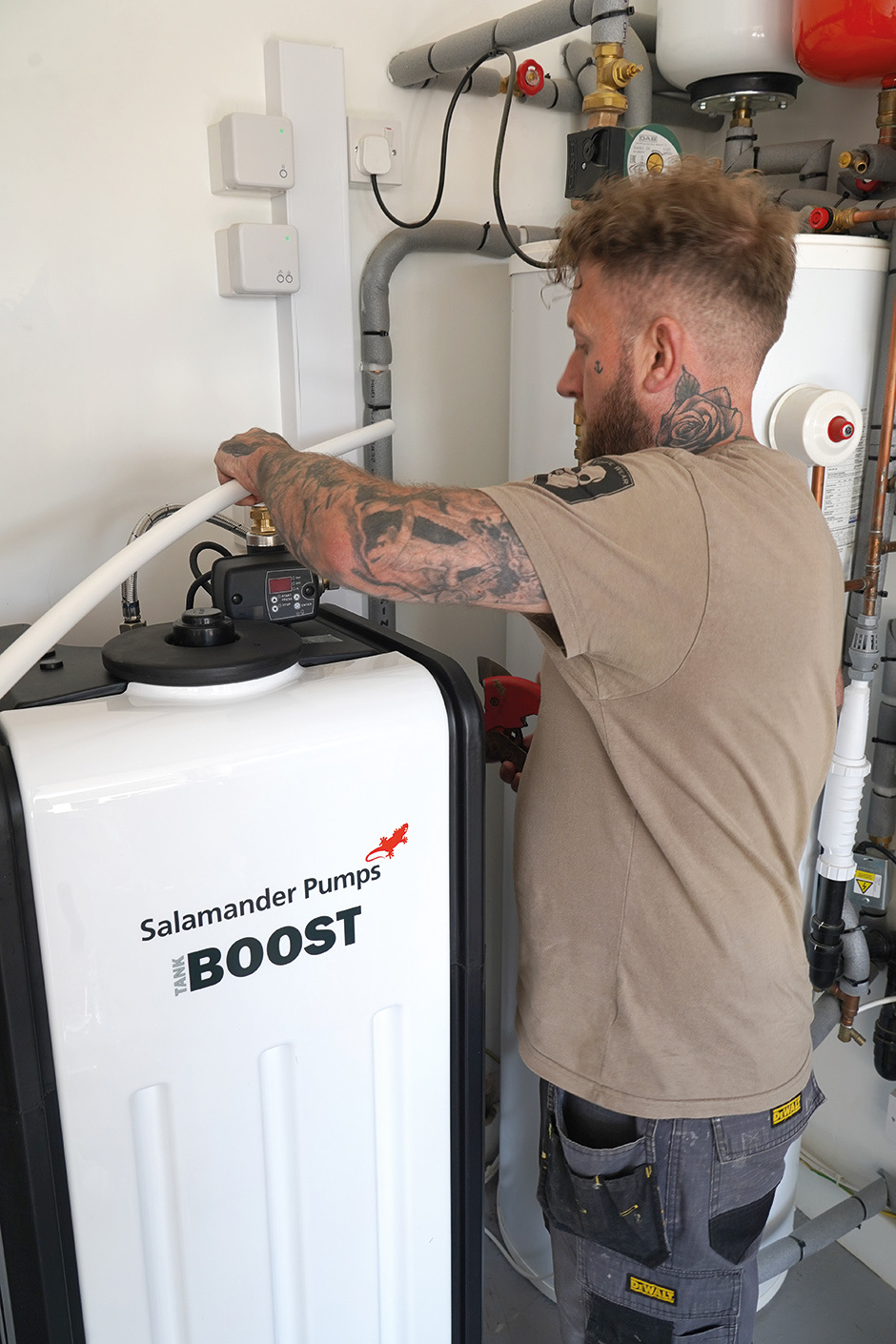
Andrew Carver, R&D manager for Salamander Pumps, discusses the importance of water pressure to achieve optimal performance in household appliances
Low water pressure and flow remain a challenge in many residential properties. Without adequate pressure and flow rates, even the highest quality appliances will underperform and customers can be left unsatisfied. It can cause a wide range of problems across the home including weak showers, poor tap flow and pressure that drops when someone flushes the toilet. In fact, low water pressure and flow is a daily occurrence for 40% of homeowners, according to research by Salamander Pumps.
Here we focus on what causes low water pressure and flow, and explore some of the solutions available to installers, focusing on a mains-fed system.
Supply and demand
Remember, water flow is the volume of water that comes from an outlet, such as a tap or shower, over a specific period of time. Whereas water pressure is the force that pushes water through pipes.
There are several factors that will influence whether the water pressure and flow in a mains-fed system is adequate.
The first is the incoming supply from the mains, which itself has two main points. The water pressure and flow at outlets and appliances is dictated by the performance of the mains supply, but this supply can fluctuate throughout the day. During peak usage times like early morning and evenings, the water performance can suffer due to increased demand.
Alongside this, under the Water Supply and Sewerage Services (Customer Service Standards) Regulations 2008 (as amended), water companies must maintain 0.7 bar water pressure in the communication pipe. In most cases this minimum standard is not enough to satisfy the demand of the property.
The second factor is water demand from within the property, particularly if demand has reached a point that the system wasn’t originally designed to meet. This could be because the family has grown, or remodelling work has been completed. A new downstairs WC, additional outlets in utility areas or a new ensuite, for example, will all increase demand.
Additionally, plumbing system design will impact water pressure. Lengthy pipe runs create friction and decrease water pressure and flow rates, while undersized pipes can restrict flow, particularly when multiple outlets are in use. Adding elbows to the pipework system introduces restrictions that can create turbulence.
Even the choice of outlets can have an impact – modern taps can be problematic, especially if they are only suitable for high pressure systems or are restrictive by design.
It’s also important to check that the combi boiler or unvented cylinder can deliver the hot water required. Consider a combi boiler designed for 15L/min – if the mains only supplies 8L/min, the system will never achieve its intended performance. Similarly, an unvented cylinder requires at least 20 L/min. Any mismatch can result in slow flow rates, inconsistent water temperature, and poor performing appliances.
Effective solution
In order to deliver a boost to the water pressure and flow in a mains-fed system, the water supply needs to be improved. There are a number of options to do this, including upgrading the incoming mains supply to the property with a wider pipe. However, this can be prohibitively expensive and disruptive, often requiring digging up the drive to lay a new pipe.
Another option is to install water-boosting solutions that can eradicate fluctuations, improve water pressure and flow, and raise customer satisfaction, with simple installation and setup. Installers have a choice of solutions, depending on the requirement.
If the required flow rate is above 12 L/min, then a stored water solution will be required.
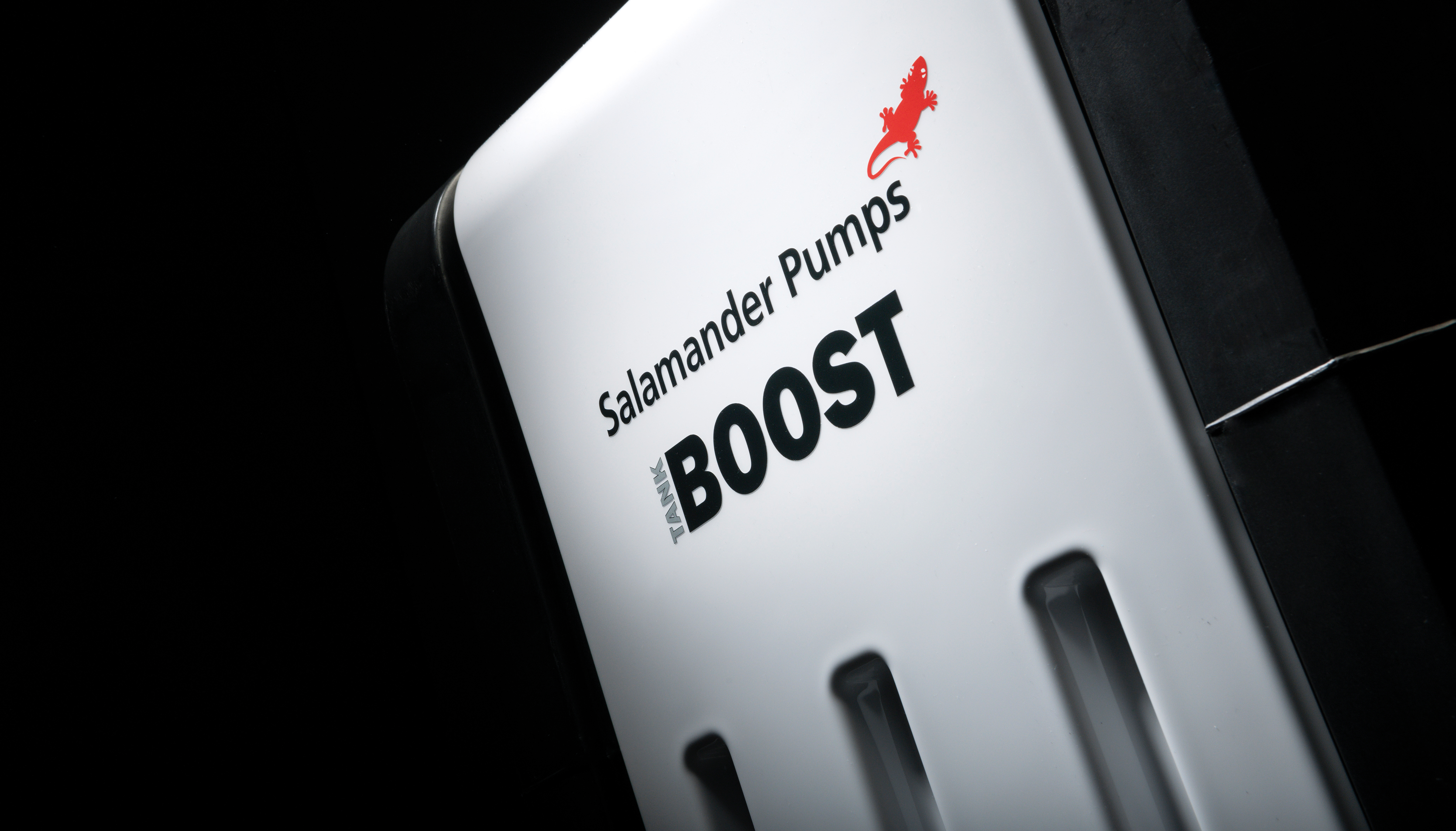
Salamander Pumps’ TankBoost, for example, is an all-in-one unit combining a storage tank and integrated submersible pump, with options capable of boosting both the pressure and flow in a mains-fed system up to 3.0 bar and 80 L/min or 5.0 bar and 120 L/min for larger/taller buildings, where greater pressure is needed to overcome inevitable pressure loss across greater pipe distances and up additional floors. Pressure drops by 0.1 bar for every metre it travels upwards, which can be significant in taller properties where outlets are located on the upper floor. There are solutions for all property types and sizes, with units in either a 100L, 200L, 350L or 450L water storage capacity, depending on the property requirements.
When choosing a water-boosting solution, it’s important to ensure that it meets the requirements of the Water Supply (Water Fittings) Regulations 1999 (for England and Wales), the Water Supply (Water Fittings) Regulations (Northern Ireland) 2009 and Water Byelaws in Scotland, for cold water storage. Look for units that include design measures to prevent backflow, with airgap and, where greater protection is required, opt for a CAT5 variant which uses a type AB airgap.
Specification considerations
Correct specification is vital to deliver the right solution. Installers should consider the following points to get the right product for the system.
First, identify the natural incoming flow rate, incoming mains static pressure and number of floors in the property. Measure the incoming pressure and flow at the garden tap as they are commonly the closest outlet to the incoming mains supply and are often unrestricted. For example, incoming flow rate of 10L/min.
Next, it’s important to ask the customer which outlets will be used at the same time and calculate the total flow rate needed in L/min. This will provide an accurate assessment of the building’s peak water demand. It’s a common mistake that specification must include all outlets, but water boosting systems only need to consider outlets in use at the same time, for example two showers and a washing machine.
For any stored water solution, the installer must establish how much additional water capacity is needed, by asking how long the maximum flow rate is required (often the length of a typical shower). With this, they can calculate the discrepancy between the incoming and outgoing flow rate, for example 10 L/min x 10 mins = 100L incoming, and 32 L/min x 10 mins = 320L outgoing. In this case, a tank storing at least 220L is needed.
Correct sizing is vital because undersizing can lead to the tanks running empty, which can damage the pump and leave the tank empty until it is refilled. However, water should not be stored in the tank for more than 24 hours to avoid stagnation, therefore it is important not to oversize.
One of the most common mistakes made in specification is to select a model based on the space available, rather than the water demand in the property.
Additional water storage units are available to boost capacity which can provide a solution when large water volumes are needed. Multiple units can be connected via a linking kit provided and the additional tank must be the same size as the pumped unit.

Installation considerations
Installation is simple for competent installers, but there are a number of things to consider, including location. The floor/mounting surface supporting the unit must be flat and level, and strong enough to withstand the weight of the unit when full, which may require additional supports. You can find the weight of units in the technical specifications.
The unit must also be sited away from direct sunlight and extreme temperatures. The stored volume of water must remain above 4°C and below 20°C in line with best practice to meet WRAS guidance and the UK Water Supply (Water Fittings) Regulations, which states ‘systems must be designed to prevent contamination or bacterial growth’. This will also protect the unit from frost and insulation jackets are available separately too.
With this in mind, a kitchen cupboard, garage, loft space or outbuilding is typically the most suitable location.
Connections
A number of connections are required to install the unit, including mains water inlet, outlet, overflow and electrical connections. If purchasing additional storage units, a linking kit to connect each additional unit will be required.
Access is needed to each of these connections for the initial installation and ongoing maintenance, and it’s also important to leave access to the pressure vessel for maintenance and space above the unit for clearance in case the pump needs to be removed. Before the unit is filled, it’s also worth considering if a drain-off point is needed, which will offer quick and efficient drainage of the tank – drain-off plugs are available to purchase separately.
A double check valve is required on the inlet pipework as part of the backflow prevention, and it is best practice to install isolating valves for maintenance and servicing.
Pipework
It’s important to note that the total flow rate will be impacted by the pipe work that comes out from the unit. For example, a 5.0 bar unit can deliver up to 120 L/min, but only if the outlet pipework from the unit to the system is sufficient. Installers may need to use a different connector depending on the size of the clients’ pipework connection.
Setup and commissioning
Make sure you read installation guides carefully, but it’s essential to fill the tank before making the outlet connection, to prevent the risk of an air lock. This is one of the main reasons for a fault during installation and setup.
Fill the unit via mains supply, make the outlet connections once full, then switch on the unit to purge the pump during the commissioning and prevent any airlocks. Many units are ‘plug and play’, with some even coming with pre-programmed settings when delivered to site, so you can simply press the power button once the unit is filled and the connections are made.
Water supply
Finally, we encourage installers to provide a drinking water supply before connecting the mains water inlet to the unit. Although this is a potable water tank, creating an independent connection via a dedicated feed beforehand will make sure the customer has a non-pumped supply as well as the pumped supply, in case of maintenance or shutdown.
For more information, visit
salamanderpumps.co.uk
You might also like

The role of heat interface units (HIUs) in modern heat networks
How to install press-fit pipework for ACR systems