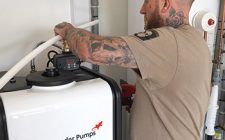
How to spot a non-compliant pump

As of 1 January 2013, it is illegal to sell standalone heating circulation pumps that don’t meet the Energy-related Products (ErP) Directive on energy efficiency. However, over the last 12 months, more than 20 brands that don’t meet these minimum efficiency standards have been identified in the UK market.
Reports have suggested that non-compliant pumps can, at times, use nearly five times the power of a compliant pump, which is unacceptable as we transition towards net zero. They can also cost the average homeowner as much as £150 extra a year at a time when they are already faced with growing bills and an increased cost of living.
The CIPHE has predominantly focused its efforts on educating the sector on areas such as low-temperature heating design, however, issues such as non-compliant pumps directly affect consumers and should be outlawed.
How to identify a non-compliant pump
In order to see whether a pump is compliant, installers need to check that there is an EEI (Energy Efficiency Index) on the pump data plate. If it does not have one then the pump is non-compliant.
If it does have an EEI shown on the data plate then a simple rule of thumb procedure can be carried out to see whether it is actually compliant (see Figure 1, below).

The importance of good design
Good pump design is critical for the efficient operation of a low-carbon heating system and while fitting a compliant pump is a quick win for energy savings, it is important that installers understand the difference between fixed and variable speed pumps.
Traditionally, central heating circulators have been operating at fixed speeds and would have been operating at these fixed speeds for the duration of its lifespan, following the initial commissioning stage. However, the introduction of more modern inverter-driven variable-speed pumps have given the pump more control over the system at varying heating loads, leading to greater energy saving.
While the fixed speed pump is set up to operate at peak cold conditions, it continues to run at these high speeds throughout the year at much lower loads. Conversely, the modern variable speed pump will modulate down to meet the varying loads during the heating season.
Proper installation
While selecting an efficient pump control is paramount, there are a number of things to take into consideration before installing a pump:
• Location
The pump should be located on the system to maintain a positive pressure around as much of the heating system as possible. The return connection to the circulator and the expansion vessel should be as close as feasibly possible.
• Neutral connection
When a pump is installed within an open-vent system, the cold feed should be connected to a neutral point on the suction side of the circulator and as close as possible.
• Perfect pressure
The circulator must be subjected to a value no lower than the minimum static pressure stated by the manufacturer.
• Middle ground
The circulator should not be installed on the lowest part of a heating system as this allows sediment to collect. It should not be installed on the highest part of the system either, as air can be a problem.
• Follow instructions
The pump should be installed to manufacturers’ instructions, typically horizontally, so there are no undue loads applied to the bearings. If the pump is installed on a vertical pipe, then you should avoid the pump being installed vertically downwards due to the difficulty of removing trapped air from the circulator impeller casing.
You might also like

The role of heat interface units (HIUs) in modern heat networks
How to install press-fit pipework for ACR systems